

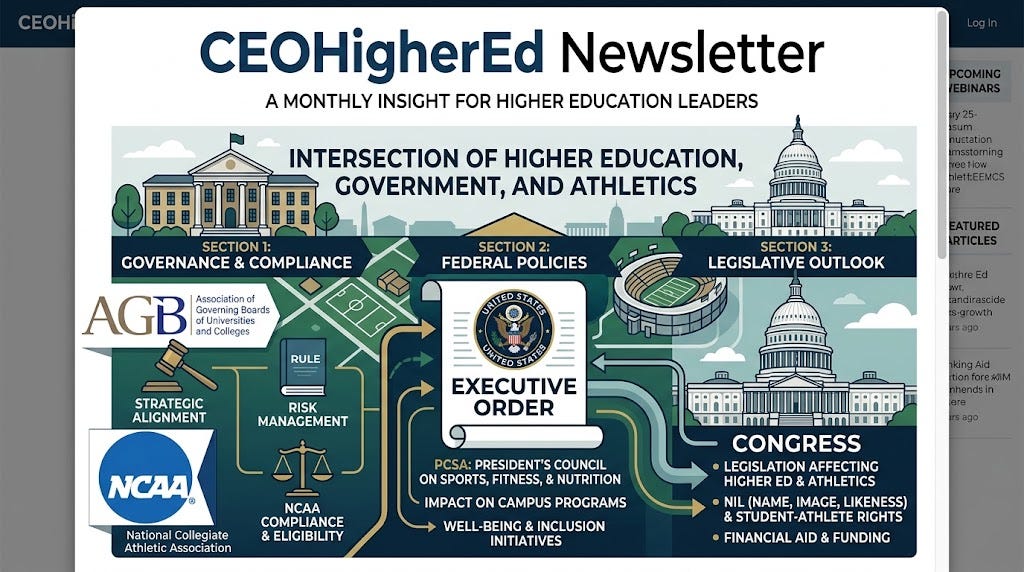
This past week, the Association of Governing Boards of Universities and Colleges (AGB) issued an executive briefing that told trustees something that, at this point, should not at all be surprising. The briefing stated that collegiate athletics is now a rapidly changing commercial enterprise, and trustees need to understand and recognize where athletics oversight fits within their own committee structure1.
AGB is the leading national organization, based in Washington, D.C., that focuses on strengthening and supporting higher education governance. It serves university presidents, board chairs, trustees, and board members. The organization represents more than 2,000 institutions and foundations and has over 40,000 individual members. Its mission is to prepare college and university governing boards to successfully fulfill their fiduciary duties and strategic responsibilities2.
But, AGB did not issue a new policy. Instead, it pointed out a governance gap that has been increasing for almost two years. This gap is one I have been following and writing about in this Substack newsletter for several months. All this comes at a critical time for collegiate athletics as three unique agents — the courts, Congress, and the White House—are each focused on universities and their athletic departments.
They are all asking much the same basic question: who, within the institution, “owns” collegiate athletics? In prior newsletters, I have referred to this situation as “governance arbitrage”. It concerns the movement of important institutional decisions from the board’s formal oversight, into areas where trustees have decreased visibility and less control. Athletics has been at the forefront of this shift for some time. This pattern has been discussed in nearly every edition of this newsletter since April, whether the topic was the shift in the business model, the wave of LLC restructurings, or the accounting treatment of coaching buyouts3.
AGB’s briefing is the clearest indication, at least to my thinking, that the sector’s own governance association views it the same way. Today, trustees are being asked to oversee, often without a well-defined committee oversight structure and charter: 1) a federal judge’s recent preliminary injunction in Wisne v. NCAA, which has already disrupted roster and eligibility planning for the 2026-27 season4; 2) The Protect College Sports Act (PCSA), which, as of this week, remains stalled in the Senate and will not be taken up again until after the August recess, leaving the effects on rosters, revenue-sharing, and retention pools unresolved5; and 3) Executive Order 14400, effective August 1, which instructs federal agencies to review institutional compliance with athletics guidelines as set by the order6.
The PCSA Stall Is Its Own Governance Story
I wrote an in-depth piece on the PCSA’s stalled progress in June, when the SEC and Big Ten released a joint statement opposing the bill’s media-rights pooling and anti-consolidation provisions. The SEC and Big Ten now support the PCSA but the bill has not advanced and is on hold until after the August recess.7 What matters for trustees now is not just these legislative details, but that conference commissioners were negotiating a governance restructuring of collegiate sports at the federal level, and in most cases, their own member-institution boards were learning about their conference’s stance from the media rather than from conference leadership. That is another case of governance arbitrage, where a decision with direct institutional impact is made with limited or no university trustee involvement.
AGB also is also very pointed in its opinion that the old athletics business model is gone, even for institutions outside the power conferences. They caution that trustees at mid-major and non-power institutions, mistakenly, dismiss such issues as not really their concern. AGB then goes further to remind universities and their governing boards that issues such as revenue-sharing and Title IX risk are not limited by conference tier. The executive order instructing agency heads to assess the “present responsibility” of grant and contract recipients based on athletics governance compliance doesn’t either. Each board that has a DI or DII program will be impacted by all this, whether it has ever come up at a board meeting or not.
LLC Spinoffs Are the Structural Version of the Same Drift
The task AGB has given trustees is fairly simple: determine which committee currently has athletics oversight—finance, risk, a dedicated athletics committee, or, perhaps, no single committee. The next step for boards is to decide, given what the athletics portfolio now includes, if the current committee structure is still optimal.
Boards that wait for the next crisis to address this might find, as some already have, that the decision is being made for them by a court, a conference, an athletic director, the board of an LLC spinoff, or a federal agency. The LLC issue is not theoretical, and it is the part of the governance story I have focused on throughout this year. Georgia Tech’s Champions Blue, Clemson Ventures, Michigan State’s Spartan Ventures, and Texas Tech Athletic Partners are all structured, in different ways, to move commercial athletics activity into an entity outside the university’s own governance and audit reach8.
I have argued that this is the clearest example of governance arbitrage in a structural sense: the university keeps the brand, the fans, and often the reputational risk; while a separate legal entity, with its own board and often its own NDA-protected agreements, makes the commercial decisions. Michigan State’s experience with Spartan Media Ventures is the cautionary example every trustee reading the AGB briefing should be considering9.
What should trustees do this fall, given that the courts, Congress, the White House, and now AGB all converging around collegiate athletics and governance?
First, determine which committee is responsible for athletics oversight, and make sure its charter explicitly states that.
Second, ask whether your athletics enterprise includes any LLC, foundation, or venture structure operating outside the university’s own audit and governance perimeter, and if so, whether the full board—not just the athletics committee or the president’s office—receives regular, substantive briefings on what that entity is doing and who it answers to.
Finally, consider how compliance with Executive Order 14400 could potentially impact your university’s existing federal grants and contracts. Institutions that have never mapped athletics governance compliance onto their federal funding relationships may be more exposed than their Office of Research realizes.
Readers new to this newsletter can find more detailed discussions of the PCSA, the LLC spinoff pattern, and Executive Order 14400 in the archive. Together, they are the resources behind what AGB is now urging trustees to investigate for themselves.
Kim Schatzel, Ph.D., is the founder of CEOHigherEd and served as president of Towson University and the University of Louisville. She served on two NCAA Division I Athletic Conference boards, including the ACC. CEOHigherEd publishes practitioner-grounded analysis of higher education governance and leadership for university presidents, provosts, trustees, legislative leaders, and policymakers.
Endnotes
1 Association of Governing Boards, “Executive Briefing: Intercollegiate Athletics and Board Oversight,” August 13, 2026.
2 Association of Governing Boards, “About AGB,” agb.org, accessed August 2026.
3 CEOHigherEd, “The Business Model of Collegiate Athletics,” April 22, 2026.
4 Hoops HQ, “Recapping a Chaotic Week in the College Sports World,” August 5, 2026, describing the NCAA’s response to the preliminary injunction in Wisne v. NCAA.
5 Sportico, “Protect College Sports Act Punted as College Sports Chaos Ensues,” August 2026.
6 Executive Order 14400, “Urgent National Action to Save College Sports,” The White House, April 3, 2026 (effective date for Sections 3-6: August 1, 2026).
7 CEOHigherEd, “Congress Is Trying to Fix College Sports. The Power 2 Don’t Like It.,” June 17, 2026.
8 CEOHigherEd, “Collegiate Athletics: New Business Model, New Governance Models, & New Legal Entities - OH MY!,” April 29, 2026.
9 CEOHigherEd, prior coverage of the Michigan State Spartan Media Ventures NDA governance matter.